Managing Multi-Currency Business Expenses in Japan
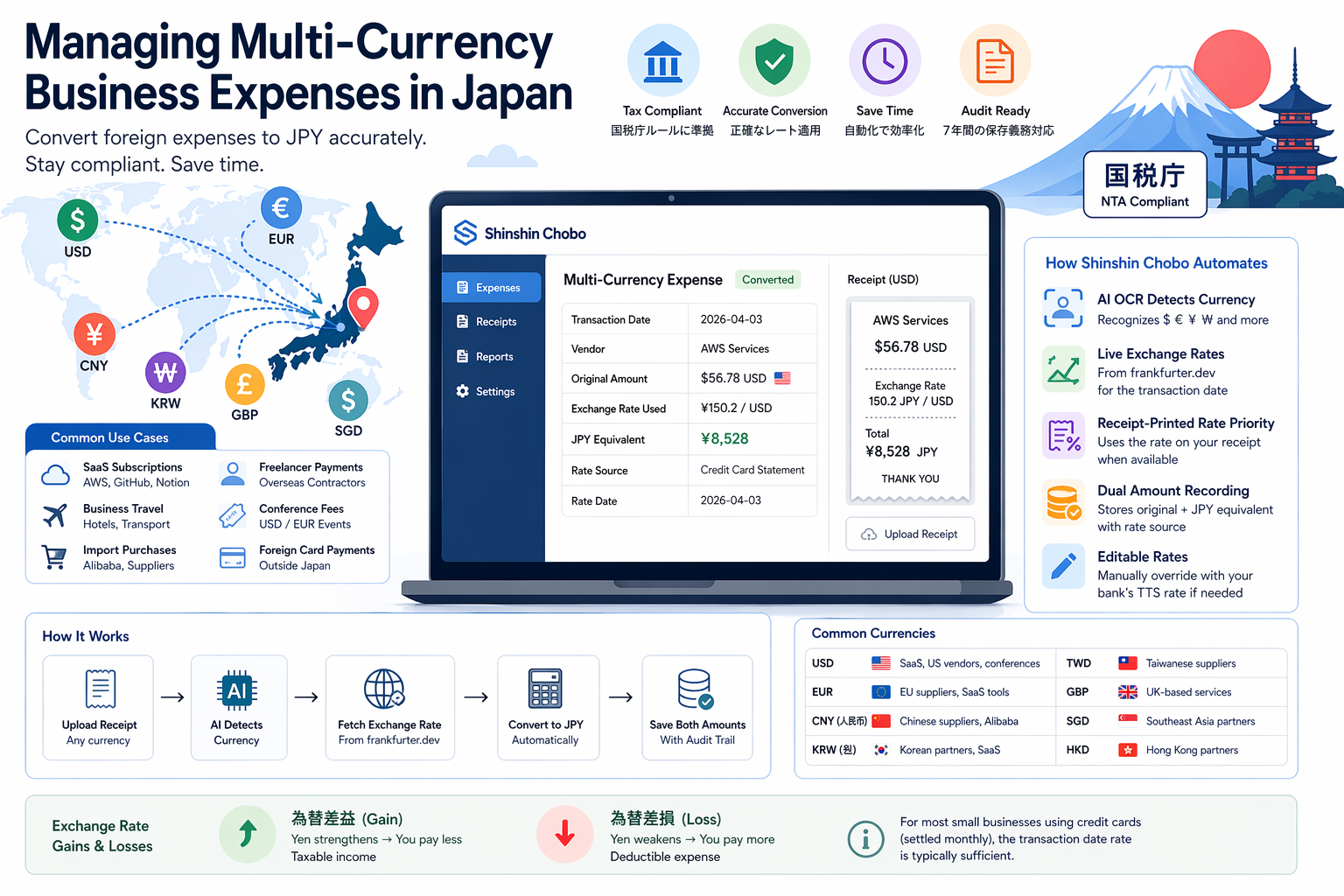
If you run an international business in Japan — importing goods, paying overseas freelancers, traveling abroad, or using foreign SaaS tools — you inevitably deal with expenses in multiple currencies.
Japan's tax system requires all expenses to be reported in Japanese Yen (JPY). Getting the conversion right is important for accurate bookkeeping and tax compliance.
When Multi-Currency Expenses Happen
Common scenarios for foreign business owners in Japan:
- SaaS subscriptions billed in USD (AWS, GitHub, Notion, Figma)
- Business travel with hotel and transport in foreign currencies
- Import purchases from overseas suppliers (Alibaba, international manufacturers)
- Freelancer payments to overseas contractors in their local currency
- Conference and event fees charged in USD or EUR
- Foreign credit card transactions from cards issued outside Japan
How to Convert Foreign Currency to JPY for Tax Filing
The Official Rule
Japan's National Tax Agency (国税庁) accepts the following exchange rates:
- TTS rate (Telegraphic Transfer Selling rate) from your bank on the transaction date — this is the most commonly accepted method
- The exchange rate at the time of transaction as shown on your credit card statement
- A reasonable market rate on the transaction date (e.g., from a recognized financial data source)
Practical Approach
For most small businesses and freelancers:
- Credit card purchases: Use the rate your card company applied (shown on your statement)
- Bank transfers: Use the TTS rate from your bank on the transfer date
- Cash purchases abroad: Use the rate from a recognized source on that date
What If You Don't Know the Exact Rate?
If the exact rate isn't available, you can use:
- The average rate for the month (月平均レート) published by the Bank of Japan
- A widely-used exchange rate service (e.g., frankfurter.dev, XE.com)
Important: Be consistent. Choose one method and use it throughout the fiscal year.
Record-Keeping Requirements
For each multi-currency transaction, you should record:
| Field | Example |
|---|---|
| Transaction date | 2026-04-03 |
| Vendor | AWS Services |
| Original amount | $56.78 USD |
| Exchange rate used | ¥150.2/USD |
| JPY equivalent | ¥8,528 |
| Rate source | Credit card statement |
Japan's 電子帳簿保存法 (Electronic Bookkeeping Act) requires that these records be:
- Stored for 7 years
- Searchable by date, amount, and vendor
- Tamper-evident (cannot be modified after recording)
Common Currencies for Japan-Based Businesses
| Currency | Common Use Case |
|---|---|
| USD | SaaS subscriptions, US vendors, international conferences |
| EUR | European suppliers, EU SaaS tools |
| CNY (人民币) | Chinese suppliers, Alibaba purchases |
| KRW (원) | Korean business partners, Korean SaaS |
| TWD | Taiwanese suppliers |
| GBP | UK-based services |
| SGD / HKD | Southeast Asian business partners |
Exchange Rate Gains and Losses (為替差損益)
When the exchange rate changes between when you incur an expense and when you actually pay, there's a gain or loss:
- Exchange rate gain (為替差益): If the yen strengthened between booking and payment — you paid less in JPY than expected. This is taxable income.
- Exchange rate loss (為替差損): If the yen weakened — you paid more. This is a deductible expense.
For small businesses with straightforward transactions (credit card charges settled monthly), the exchange rate on the transaction date is typically sufficient and no separate gain/loss calculation is needed.
Challenges of Manual Multi-Currency Tracking
Without automation, managing multi-currency expenses means:
- Looking up exchange rates for every foreign transaction
- Manual conversion calculations (error-prone with many transactions)
- Tracking which rate source you used for each transaction
- Maintaining dual records (original currency + JPY)
- Ensuring consistency across hundreds of transactions per year
For a business with 20+ foreign transactions per month, this easily adds 2-3 hours of bookkeeping monthly.
How Shinshin Chobo Automates This
Shinshin Chobo handles multi-currency expenses automatically:
Automatic Currency Detection
Upload a receipt in any currency. The AI OCR detects the currency from the receipt text ($ for USD, € for EUR, ¥ for JPY/CNY, ₩ for KRW, etc.).
Live Exchange Rate Conversion
The system automatically fetches the exchange rate for the transaction date from a reliable financial data source (frankfurter.dev) and converts to JPY. Rates are cached for efficiency.
Receipt-Printed Rate Priority
If the receipt itself shows an exchange rate (common with credit card receipts), that rate takes priority over the API rate — matching what your card company actually charged.
Dual Amount Recording
Both the original amount and the JPY equivalent are stored:
- Original: $56.78 USD
- Converted: ¥8,528 (at ¥150.2/USD)
- Rate source and date are recorded for audit trail
Editable Exchange Rates
If you need to use a specific rate (e.g., your bank's TTS rate), you can manually override the automatic rate in the edit panel.
Tips for Managing Multi-Currency Expenses
- Use one credit card for all foreign purchases — simplifies rate tracking since the card statement is your rate source
- Record expenses promptly — exchange rates change daily, and matching the correct date matters
- Keep rate documentation — save credit card statements or note which rate source you used
- Be consistent — don't switch between bank rates and market rates mid-year
- Use accounting software that handles conversion automatically — manual tracking doesn't scale
Frequently Asked Questions
Which exchange rate should I use for tax filing in Japan?
The TTS rate from your bank on the transaction date is the safest choice. Alternatively, the rate shown on your credit card statement is also widely accepted.
Do I need to report the original foreign currency amount?
While not strictly required on the tax return itself (which is all in JPY), keeping records of both the original amount and the conversion is good practice and may be required during a tax audit.
Can I use a monthly average rate instead of daily rates?
Yes, the National Tax Agency accepts the monthly average rate (月平均レート) as a reasonable alternative. This simplifies bookkeeping significantly.
How does Shinshin Chobo handle currencies it doesn't recognize?
You can manually set the currency and exchange rate for any receipt. The system supports all major world currencies for conversion to JPY.
What about cryptocurrency transactions?
Cryptocurrency is treated as property in Japan, not currency. Crypto gains and losses have separate reporting rules. Shinshin Chobo focuses on fiat currency expense management.
Is multi-currency support available on the free plan?
Yes. Multi-currency receipt upload, automatic exchange rate conversion, and dual-amount recording are all available on Shinshin Chobo's free Standard plan.